
Hybrid Cloud Strategies That Will Win in 2026
- Niotechone Marketing Team
Table of Contents
- Introduction
- What Is Hybrid Cloud and Why It Matters in 2026
- Key Drivers Behind Hybrid Cloud Adoption in India
- Strategy 1: Cloud Distribution by Workload
- Strategy 2: Cloud-Native Core and Legacy Integration
- Strategy 3: Hybrid DevOps and CI/CD Pipelines
- Strategy 4: AI-Ready Hybrid Architectures
- Strategy 5: Data Management and Compliance
- The Future of Hybrid Cloud Beyond 2026
- Conclusion
Introduction
With the increasing pace of digital transformation in India, companies are no longer using single-cloud or on-premise models. The winning strategy in 2026 is hybrid cloud, which is a strategy that integrates on-premise infrastructure, private clouds, and public cloud platforms into a single ecosystem. The model is flexible, cost-controllable, secure, and performance-based, which is why it is suitable for enterprises, startups, and growing organizations.
Hybrid cloud is no longer a dream for every software development company in Rajkot. It forms the foundation of scalable, AI-ready, and compliance-driven systems. Regardless of whether you are developing enterprise platforms, travel portals, or mobility solutions, long-term success will be characterized by hybrid cloud strategies.
What Is Hybrid Cloud and Why It Matters in 2026
Hybrid cloud combines various computing environments into one architecture. In contrast to pure public cloud models, hybrid systems enable businesses to retain sensitive data on-premise and use the scalability of the cloud to drive innovation.
This practice is becoming more popular in custom software development in India because of the growing data regulations, performance requirements, and the fast development of AI-driven applications. Businesses desire flexibility without losing control.
Hybrid cloud allows organizations to modernize their legacy systems and move to cloud-native technologies at their own speed.
Key Drivers Behind Hybrid Cloud Adoption in India
The IT ecosystem in India has its own challenges and opportunities. The adoption of hybrid clouds is not hype-driven but is based on practical business requirements.
Major drivers include:
- Regulatory compliance and data residency.
- Large workload cost optimization.
- Interoperability with legacy enterprise systems.
- Increasing use of AI and analytics.
In the case of businesses that have a .NET development company in Rajkot, hybrid cloud provides a middle ground to innovation without interfering with the current operations.
Key Hybrid Cloud Strategies Driving Success in 2026
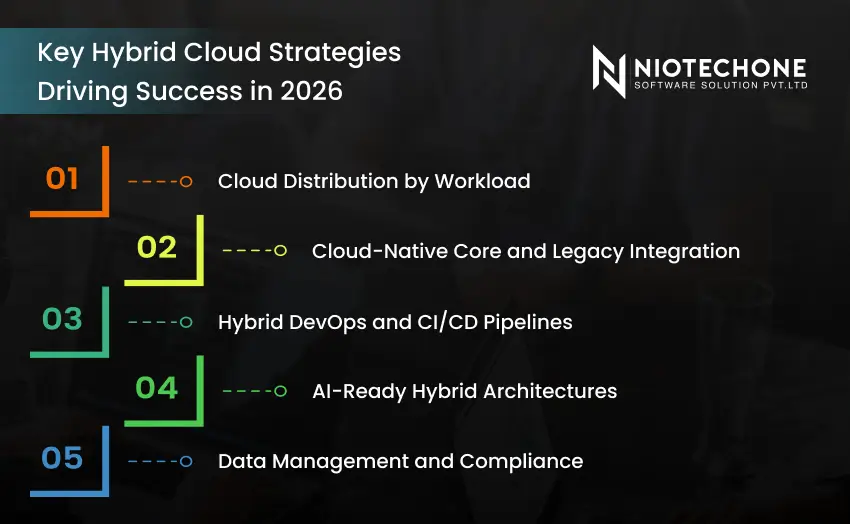
Strategy 1: Cloud Distribution by Workload
The purpose, sensitivity, and performance needs of workloads are one of the most effective hybrid cloud strategies in 2026. Not all applications should be fully deployed in the public cloud.
Financial data, internal ERP systems, or customer records are critical workloads that are typically kept on-premise, whereas scalable components such as analytics, customer portals, and mobile APIs are typically run on the cloud.
This is a typical approach in the development of Azure cloud applications whereby Azure is easily integrated with on-premise environments. ASP.NET Core development teams in Rajkot usually create applications that are capable of dynamically shifting workloads according to demand.
Strategy 2: Cloud-Native Core and Legacy Integration
Instead of completely rewriting legacy systems, businesses in 2026 are creating cloud-native layers on top of existing infrastructure. This strategy minimizes risk and speeds up innovation.
With the help of .NET Core application development, developers are able to develop modern APIs and microservices that can be connected to legacy databases and systems in a secure manner. These services operate in the cloud with core systems on-premise.
This approach is common in bespoke software development in India, particularly in such sectors as travel, logistics, healthcare, and manufacturing.
Strategy 3: Hybrid DevOps and CI/CD Pipelines
The success of hybrid clouds is largely determined by the way applications are developed, tested, and implemented. DevOps pipelines should be able to support on-premise and cloud environments in 2026.
Contemporary CI/CD pipelines enable teams to deploy code in hybrid environments without issues. This guarantees quicker releases, quality control, and performance.
Key benefits include:
- Faster time-to-market
- Reduced deployment risks
- Improved teamwork.
Hybrid-ready DevOps pipelines have become the norm in every progressive software development company in Rajkot.
Strategy 4: AI-Ready Hybrid Architectures
The adoption of AI is booming in Indian businesses, yet not all data can be transferred to the public cloud. Hybrid cloud enables organizations to train AI models on on-premise data and execute inference and analytics in the cloud.
Hybrid architectures are being employed in AI in Software Development in Rajkot to balance performance, security, and cost. Sensitive training data remains local, and cloud resources are used to process compute-intensive workloads.
This strategy allows companies to be creative with AI without jeopardizing data governance.
Strategy 5: Data Management and Compliance
Security is a priority in 2026. Hybrid cloud enables organizations to exercise stringent security measures on sensitive data and still enjoy the benefits of cloud scalability.
The main security practices are:
- Zero-trust access models
- Synchronization of encrypted data.
- Single identity management.
Businesses that develop tailor-made Enterprise mobility software solutions are dependent on hybrid cloud to provide secure access to devices, locations, and networks.
The Future of Hybrid Cloud Beyond 2026
The adoption of hybrid clouds is projected to increase exponentially after 2026 due to the advancements in AI, edge computing, and automation. The systems of the future will not only allocate workloads between the private and the public clouds but will also make intelligent decisions on where to execute tasks depending on the cost, performance, and security. The AI-based orchestration will automate the allocation of resources, anticipate traffic peaks, and optimize storage and compute utilization in real-time.
Hybrid cloud will also be extended by edge computing. Organizations will handle important data near the source, e.g., IoT devices or mobility platforms, and use the cloud to perform intensive computation and analytics. This is especially applicable to businesses that invest in tailor-made Enterprise mobility software solutions, which guarantee quicker response time and lower latency among applications.
Conclusion
Hybrid cloud is not a technological experiment anymore; it is a strategic facilitator of businesses that want to compete in 2026 and further. Today, companies that implement hybrid cloud strategies can be scaled, resilient, secure, and innovative at the same time. Hybrid cloud offers the flexibility and reliability that modern enterprises require whether it is the deployment of AI models, managing unpredictable workloads, or providing seamless mobile experiences.
To gain a competitive advantage, it is necessary to collaborate with an established .NET development company in Rajkot or to use custom software development in India. These teams have extensive experience in ASP.NET Core development in Rajkot, and AI in Software Development in Rajkot, which means that hybrid cloud deployments are performance-optimized, cost-effective, and scalable in the long term. Concisely, the future-ready digital transformation is based on hybrid cloud.
Categories
Related Articles

Related Tags
Frequently Asked Questions FAQs
A hybrid cloud approach is a combination of on-premise infrastructure, private clouds, and public cloud platforms to form a flexible, scalable, and secure computing environment.
Travel portals with varying traffic and those that need real-time updates are best suited to hybrid cloud. On-premise systems can be used to book data and cloud platforms to provide analytics, search, and recommendations to a Travel portal software development company in Rajkot.
Rajkot is becoming a technology hub with good talent in .NET Core application development, ASP.NET Core development in Rajkot, and Azure cloud application development.
AI workloads frequently demand the processing of sensitive data and the utilization of scalable compute resources. Hybrid cloud allows training AI models on-premise using secure data, and inference and analytics are performed on cloud resources.
The pitfalls are poor workload distribution, absence of integration planning, inconsistent security policies, and inadequate monitoring. A professional .NET development company in Rajkot or custom software development in India will make sure that hybrid cloud architecture is developed with governance, scalability, and security in mind.


