In the hyper-digital world today, technology is evolving at a rate that is usually faster than the expectations of the users. What used to be considered innovative, such as responsive design, personalization of apps, or voice control, is now the minimum. The users now demand software that knows them, can adapt to their needs and can react intelligently in real time.
This shift in expectation has created a groundbreaking idea in digital design Adaptive UX (User Experience). In contrast to traditional or responsive interfaces, which simply change layouts depending on the device, Adaptive UX is more profound, relying on artificial intelligence, behavioral insights, and contextual data to create experiences that keep changing with every interaction.
In Niotechone Software Solution Pvt. Ltd. a reputed .NET development company in Rajkot, Adaptive UX is the next big thing in software design – a combination of creativity and computation, empathy and intelligence. We are assisting companies in India and other parts of the world in creating applications that are truly intelligent, human-centered, through our knowledge of Azure cloud application development, .NET Core frameworks, and AI in software development.
Adaptive UX, also known as Adaptive User Experience, is a design philosophy in which interfaces are designed to automatically adapt and optimize themselves to the unique context, habits, and interactions of each user.
Think of opening a web portal and it immediately shows you the features you use the most, eliminates distractions you never pay attention to, and suggests what you should do before you even type in a search query. That is the strength of adaptivity.
In contrast to the static interfaces that appear similar to all users, Adaptive UX systems use AI models and user analytics to dynamically adjust layouts, prioritize content, and streamline workflows. These smart systems do not only see users as accounts but as dynamic individuals with dynamic preferences, behaviors, and objectives.
To businesses, this translates to increased engagement, reduced drop-offs and interfaces that get smarter as they are used.
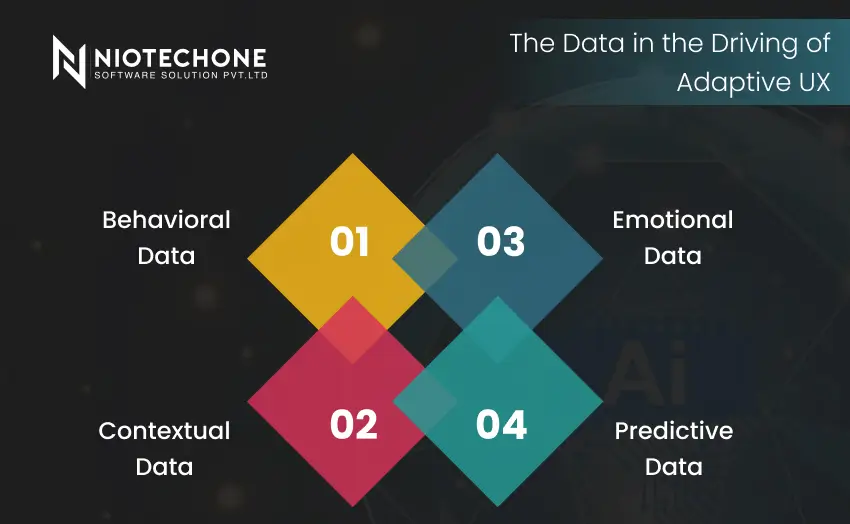
The core of Adaptive UX is data. In its absence, no system can actually learn or adapt. All adaptive interfaces are based on the principle of continuous feedback loops that monitor user actions and convert them into significant enhancements.
The most important types of data driving Adaptive UX:
Â
Together, these data layers enable applications to optimize themselves – similar to how streaming services get to know your watching patterns or CRMs customize dashboards based on the user.
To handle and safeguard this information safely, the developers of Niotechone apply the analytics, data encryption, and the integration of the .NET Core of the Azure Cloud, which guarantees the adaptive designs to be efficient, ethical, and enterprise-ready.
Adaptive experience construction needs a carefully coordinated architecture that connects AI models, data pipelines, and front-end interfaces.
The following is a simplified diagram of the Adaptive UX architecture employed in modern enterprise systems:
1. Data Collection Layer
Gather behavioral, contextual, and real-time user interaction data with event listeners and analytics APIs.
2. AI/ML Processing Engine
Uses machine learning models to understand user patterns and make the next best interaction.
3. Decision-Making Layer
Decides what should be changed – e.g. displaying alternative menus, rearranging items, or changing the tone of the content.
4. Presentation Layer
Applies the changes in real-time using front-end frameworks, which allows a smooth transition without reloading.
5. Feedback Loop
With every new interaction, the system becomes more refined, and the accuracy of future experiences is better predicted.
Using ASP.NET Core development with Azure Cognitive Services, the development teams of Niotechone in Rajkot develop adaptive systems that integrate performance, security, and intelligence, and do so without losing visual consistency across devices.
Business-wise, Adaptive UX is not merely a matter of aesthetics or convenience, but a performance-based approach that directly influences the return on investment.
As applications become smart, users are kept longer, conversion rates increase and support expenses are reduced. Adaptive interfaces make it easier to make decisions, predict needs, and minimize confusion, which leads to increased satisfaction and loyalty.
As an example, an analytics dashboard with Adaptive UX could automatically highlight the most useful metrics every morning, saving employees hours of manual filtering. A retail portal may observe that users often leave carts and rearrange layouts or suggestions to avoid abandonment.
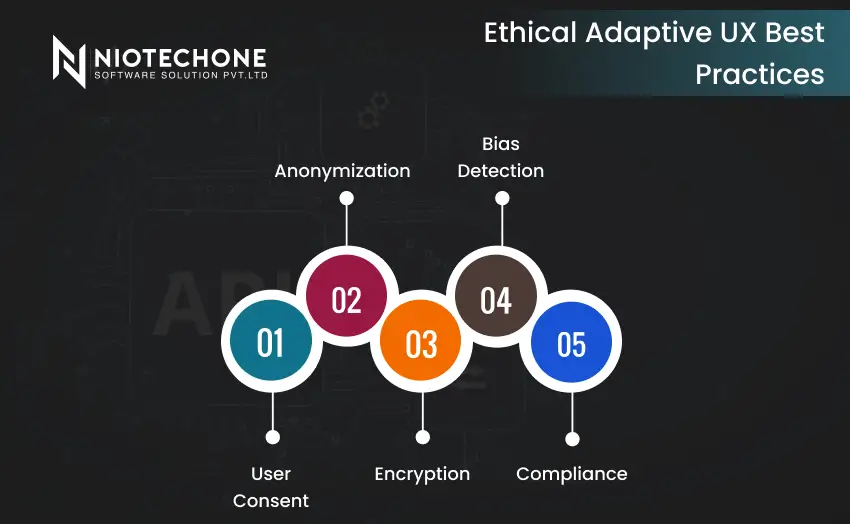
Intelligence comes with a lot of responsibility. Adaptive systems deal with sensitive user information, and therefore privacy, transparency, and security should be incorporated at all levels.
Adaptive UX Security and Ethics:
Adaptive UX represents the beginning of a period in digital design where intelligence converges with empathy. Adaptive UX pushes us beyond static templates to fluid experiences and allows every engagement to become an opportunity for learning and enhancement.
Niotechone Software Solution Pvt. Ltd. enables businesses to undertake this transformation with confidence by putting AI to work in both the software development process with .NET Core architecture and leveraging Azure’s cloud capabilities.
We design and develop more than just interfaces; we design and develop systems that adapt, engage, and learn. The theme of blurring the lines between human behavior and technology is advancing, and Adaptive UX is the bridge — where we are always remembering to put humanity back in innovations.
Responsive design alters layouts based on the end device; Adaptive UX takes this a step further by altering the interfaces based on user behavior, intent, and preference to make the experience smarter over time.Â
Definitely. Adaptive UX can personalize dashboards, workflows, and tools for each role, making the experience more efficient and easier to provide training in large organizations.Â
Not necessarily. By leveraging scalable tools like .NET Core and Azure Cognitive Services, we are able to integrate adaptive systems to existing products at a reasonable cost.Â
With user consent via consent mechanisms, encryption, and global standards like GDPR, Adaptive UX keeps user data as secure and ethical as possible.Â
AI Models, the Azure Cloud, .NET Core, and the most advanced analytics frameworks work together to build an adaptive system that is dynamic from a user experience and secure.
Copyright © 2026 Niotechone Software Solution Pvt. Ltd. All Rights Reserved.