Privacy-Enhancing Computation: Protecting Sensitive Data

Introduction:

As enterprises increasingly rely on digital platforms, the importance of protecting sensitive data has never been greater. Traditional methods of securing data, such as encryption and firewalls, are no longer sufficient in an era of cloud computing, AI-driven analytics, and interconnected systems. Privacy-enhancing computation (PEC) emerges as a powerful approach, enabling organizations to process, analyze, and share sensitive data without exposing it.

For .NET development companies in Rajkot, software development companies in Rajkot, and teams specializing in web development, custom software development, Azure cloud application development, ASP.NET Core development in Rajkot, .NET Core application development, and custom enterprise mobility software solutions, understanding PEC is crucial to maintaining trust, compliance, and security in 2025 and beyond. Integrating AI in software development in Rajkot alongside PEC strategies can help companies deliver secure, intelligent applications that respect user privacy while leveraging advanced data insights.

What is Privacy-Enhancing Computation Explained by Niotechone

What is Privacy-Enhancing Computation?

Privacy-enhancing computation refers to a set of technologies and methodologies that allow data to be processed and analyzed securely while maintaining confidentiality. Unlike traditional data protection methods that focus solely on storage security, PEC ensures privacy even when data is actively used for computation.

Key techniques include:

  • Homomorphic Encryption (HE): Enables computation on encrypted data without decrypting it.
  • Secure Multi-Party Computation (SMPC): Allows multiple parties to jointly compute a function over their inputs without revealing individual data.
  • Federated Learning: Trains machine learning models across decentralized devices without sharing raw data.
  • Differential Privacy: Introduces controlled noise to datasets to prevent identification of individual records.

For .NET development companies in Rajkot, adopting PEC allows secure handling of sensitive enterprise and customer data in web development, Azure cloud application development, and custom software development projects.

Why Privacy-Enhancing Computation Matters

With the increasing amount of sensitive data collected and processed, PEC offers several compelling benefits for enterprises:

1. Regulatory Compliance

Data privacy regulations like GDPR, CCPA, HIPAA, and India’s evolving Data Protection Bill mandate strict handling of personal and sensitive data. PEC enables organizations to comply by design, reducing the risk of fines and reputational damage.

2. Secure Data Collaboration

PEC allows businesses to collaborate with partners and third-party vendors without exposing raw data. This is particularly valuable in sectors like finance, healthcare, and government, where data sensitivity is paramount.

3. Trust and Brand Reputation

Maintaining user privacy is not only a legal requirement but also a competitive differentiator. Organizations adopting PEC demonstrate commitment to responsible data handling, enhancing customer trust.

Key Privacy-Enhancing Computation Techniques

1. Homomorphic Encryption (HE)

Homomorphic encryption allows computations to be performed on encrypted data without revealing its contents. This enables secure cloud processing, ensuring that sensitive information remains confidential even when processed by third-party systems.

Use Case:

A .NET development company in Rajkot can implement HE in a cloud-based payroll application, allowing Azure cloud application development teams to compute salaries and deductions without exposing individual employee data.

2. Secure Multi-Party Computation (SMPC)

SMPC enables multiple parties to jointly perform computations while keeping their individual inputs private. No party sees the others’ data, yet the collective result is accurate.

Use Case:

In collaborative analytics for web development projects across organizations, SMPC allows different companies to derive insights from shared datasets without revealing proprietary information.

3. Federated Learning

Federated learning trains AI models across decentralized devices without transferring raw data to a central server. Only model updates are shared, preserving user privacy.

Use Case:

Custom enterprise mobility software solutions that use predictive analytics can train AI models on mobile devices using federated learning, ensuring sensitive user data never leaves the device.

4. Differential Privacy

Differential privacy adds statistical noise to datasets to prevent individual identification while retaining overall analytical value.

Use Case:

A .NET Core application development team can implement differential privacy in user behavior analytics for an e-commerce app, protecting individual shoppers’ identities while gaining actionable insights.

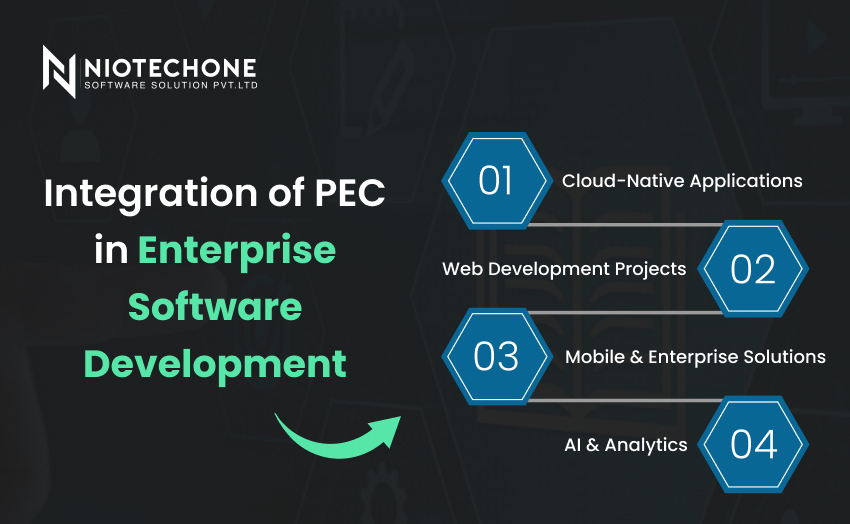
Integration of Privacy-Enhancing Computation (PEC) in Enterprise Software Development

Integration of PEC in Enterprise Software Development

For software development companies in Rajkot, integrating PEC into modern enterprise applications ensures security without sacrificing functionality:

1. Cloud-Native Applications

Cloud-native applications benefit from PEC by enabling secure multi-tenant deployments, Azure cloud application development, and scalable analytics without exposing sensitive data.

2. Web Development Projects

PEC can protect user input, transactional data, and behavioral analytics in web development projects, ensuring privacy while enabling personalization and AI-powered recommendations.

3. Mobile & Enterprise Solutions

Custom enterprise mobility software solutions can adopt PEC techniques to secure sensitive user data, including location, health, or financial information, while still offering intelligent features powered by AI.

4. AI & Analytics

By combining PEC with AI in software development in Rajkot, teams can build predictive models, recommendation engines, and fraud detection systems without accessing raw sensitive data.

Example: A healthcare SaaS platform developed by a .NET development company in Rajkot can use federated learning to improve diagnostic models across multiple hospitals while maintaining patient privacy.

Challenges and Considerations

While PEC offers numerous benefits, integrating it into enterprise software comes with challenges:

1. Performance Overhead

Techniques like homomorphic encryption and SMPC can be computationally intensive.

Optimizing performance is essential for real-time web development or mobile applications.’

2. Complexity

Designing, implementing, and maintaining PEC solutions requires specialized knowledge.

Teams may need training in cryptography, AI integration, and cloud-native development.

3. Compatibility

Integrating PEC into existing ASP.NET Core development in Rajkot or Azure cloud application development workflows may require architecture adjustments.

4. Cost Considerations

High computational overhead can increase infrastructure costs, particularly in custom software development and custom enterprise mobility software solutions.

5. Regulatory Nuances

Organizations must understand local and international privacy regulations.

PEC should complement, not replace, other data protection measures like encryption, access controls, and anonymization.

Best Practices for Integrating PEC

  • Assess Data Sensitivity: Identify which datasets require PEC protection.
  • Combine with Traditional Security: Use PEC alongside encryption, access control, and auditing.
  • Choose the Right Technique: Homomorphic encryption, federated learning, or SMPC depending on application requirements.
  • Optimize Performance: Balance privacy with computational efficiency, particularly in web development and custom software development projects.
  • Train Teams: Educate developers on cryptography, AI integration, and compliance considerations.
  • Monitor & Audit: Continuously monitor PEC solutions for performance, security, and compliance.

Practical Applications of PEC in 2025

1. Finance and Banking

  • Protect sensitive customer data while enabling cross-institution analytics.
  • Use ASP.NET Core development in Rajkot to build secure fintech applications with AI-driven insights.

2. Healthcare

  • Ensure patient privacy while sharing medical data for research.
  • Custom enterprise mobility software solutions can leverage federated learning for predictive diagnostics.

3. E-Commerce

  • Protect user purchase history and preferences.
  • Use differential privacy to gain actionable insights without compromising individual identities.

4. Government and Public Sector

  • Facilitate secure collaboration between departments and agencies.
  • Maintain compliance with privacy regulations while processing sensitive citizen data.

5. AI-Powered Enterprise Applications

  • Combine AI in software development in Rajkot with PEC to build recommendation engines, fraud detection, and predictive analytics while safeguarding sensitive data.

Conclusion

Privacy-enhancing computation is transforming how enterprises handle sensitive data. For .NET development companies in Rajkot, software development companies in Rajkot, and teams focused on web development, custom software development, Azure cloud application development, ASP.NET Core development in Rajkot, .NET Core application development, and custom enterprise mobility software solutions, PEC offers a pathway to innovate securely.

By combining PEC techniques with AI in software development in Rajkot, businesses can build intelligent, privacy-aware applications that comply with regulations, foster trust, and enable data-driven insights without compromising security. In a world increasingly conscious of privacy, adopting PEC is no longer optional—it’s essential.

Frequently Asked Questions FAQs

PEC refers to technologies and methods that enable data to be processed and analyzed securely without exposing sensitive information.

Key techniques include homomorphic encryption, secure multi-party computation, federated learning, and differential privacy.

PEC ensures security, regulatory compliance, and data privacy while allowing AI-driven insights and collaboration.

Yes, PEC frameworks like Microsoft SEAL support .NET Core application development and ASP.NET Core development in Rajkot.

PEC enables mobile applications to process sensitive data locally or securely in the cloud without exposing raw user data.